Table of Contents
- Quick answer: condo painting in Toronto (2026)
- What does condo painting cost in Toronto?
- What the law actually says
- When's the cheapest time of year to book?
- How do you hire the right condo painter in Toronto?
- How long does it take to paint a condo?
- How do you prepare your condo for painters?
- What about pregnancy, allergies, or a sensitive household?
- Should you DIY or hire a pro to paint your condo?
- How do you paint condo ceilings, including high ceilings?
- How to choose colours for a condo
- Which paint finish or sheen is right for each room?
- What are the best paint brands for condo painting?
- Ready for a fresh-looking condo?
Quick answer: condo painting in Toronto (2026)
Painting a Toronto condo in 2026 typically costs $900 to $3,200 depending on size, takes one to three days, and requires a service-elevator booking plus a certificate of insurance for most buildings. The biggest cost drivers are unit size, ceiling height, how much patching the walls need, and whether the unit is furnished or empty.
Key Takeaways
- Walls run $2.50 to $4.00 per floor square foot and ceilings $1.50 to $2.25; the real measurement is wall surface area, roughly 3.2 times the floor area at standard 8-9 foot ceilings.
- Toronto Municipal Code Chapter 591 caps construction noise at 7 am to 7 pm weekdays and 9 am to 7 pm Saturdays. Your building's declaration is almost always stricter, usually 9 to 5.
- Section 98 of the Ontario Condominium Act, 1998 only governs common-element changes. Painting inside your unit is not a common-element change. Painting the hallway-facing side of your door is.
- We use Benjamin Moore exclusively. Aura is zero-VOC, covers 350-400 sq ft per US gallon, and recoats in one hour at room temperature per its TDS.
- Pre-1990 buildings can carry lead in trim enamel, a designated substance under O. Reg. 490/09 with a 0.05 mg/m³ exposure limit. We spot-test before any sanding.
- Every job carries a five-year workmanship warranty.
If you'd rather skip the regulatory and product chemistry and just see what the service includes, the condo painting service detail page has Bronze/Silver/Gold tier pricing, the 10-step prep checklist, and the building-coordination workflow.
Painting a condo isn't the same job as painting a house. I'll tell you what most people get wrong: they figure paint is paint and the building is just a building. It's not. In a tower you're sharing one freight elevator with movers and trades you've never met, working inside hours property management dictates, and following rules a condo board wrote on top of provincial law. The walls themselves don't care, but everything around the walls does.
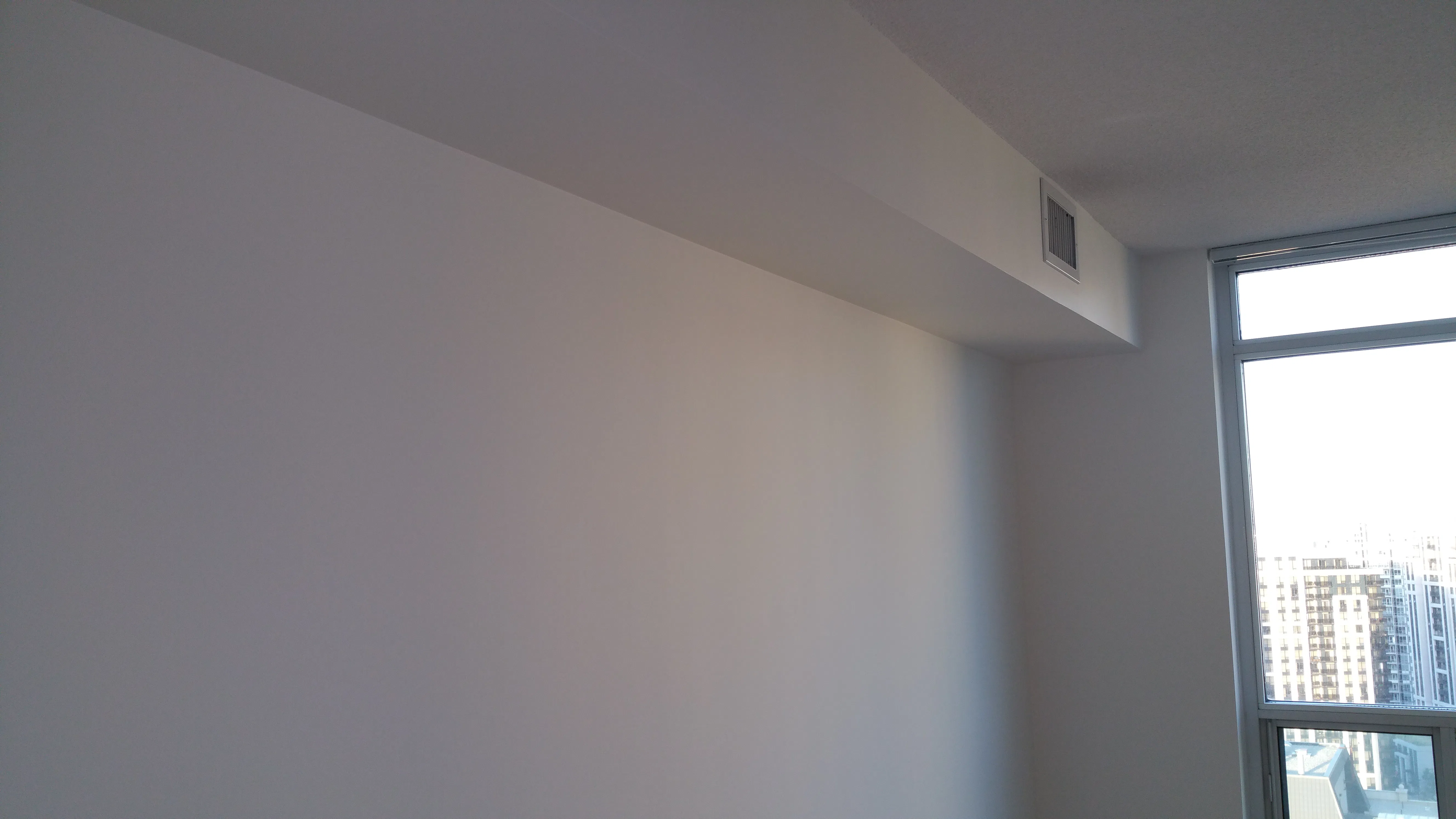
A house painter parks in the driveway and runs the job on their own clock. We can't. The loading dock has a queue, the concierge logs you in, the elevator gets booked in two-hour windows, and the sealed-window air means a paint that smells fine in a house can drive your neighbours out of theirs. Then there's the lighting. Newer condo pot lights rake across the wall at a low angle, and they will find every roller mark, every patched nail pop, every shortcut. I've walked into units where the previous painter clearly knew houses, didn't know condos, and left a mess that's harder to fix than it would have been to do right the first time.
We paint across the downtown core, midtown, North York, Etobicoke, Scarborough, and the wider GTA. Every building has its quirks, but what's in this guide holds everywhere: the numbers, the laws, the products, the order of operations. I've put it together the way I'd explain it on a walkthrough with a new client.
What does condo painting cost in Toronto?
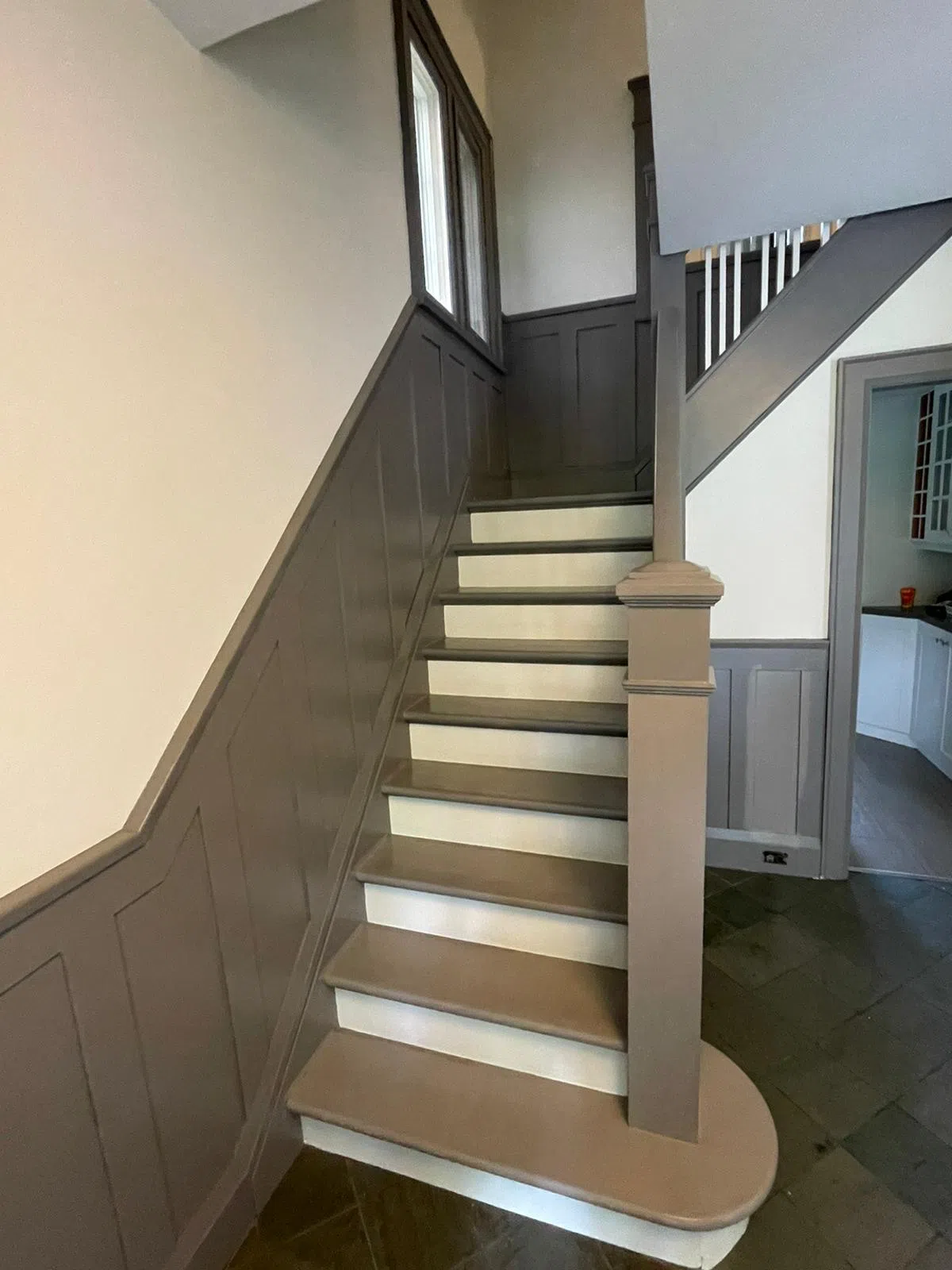
In 2026, on our Toronto condo projects, walls run $2.50 to $4.00 per floor square foot and ceilings $1.50 to $2.25 per floor square foot. A 500 sq ft one-bedroom typically costs $900 to $1,200, an 800 to 1,000 sq ft unit lands at $1,600 to $2,500, and a 1,200-plus sq ft two or three-bedroom runs $2,400 to $3,200. All figures are before HST of 13 percent.
| Unit size | Typical price (2026, CAD) | Timeline |
|---|---|---|
| 500 sq ft 1-bedroom | $900 to $1,200 | 1 day |
| 800 to 1,000 sq ft | $1,600 to $2,500 | 1.5 to 2 days |
| 1,200+ sq ft | $2,400 to $3,200 | 2 to 3 days |
Wall area is what we actually price
Pros quote per floor square foot because it is easy for owners to understand, but the calculation behind the number uses wall surface area. A rough rule for Toronto condos:
- Standard 8 to 9 foot ceilings: wall area ≈ floor area × 3.2
- Newer towers with 9 to 10 foot ceilings: wall area ≈ floor area × 3.5
- Lofts and 10-foot-plus ceilings: wall area ≈ floor area × 3.8 or higher
Worked example. Take a 700 sq ft one-bedroom with 9-foot ceilings. Floor times 3.4 gives you about 2,450 square feet of wall to paint. At roughly $1.00 per wall square foot for labour and material on a proper two-coat job, that's $2,450. Quote the same unit at $2.50 per floor square foot and you get $1,750. The $700 gap is where the cheap quote is cutting something. I've never seen one of those cheap quotes include real prep, two real coats, and a top-tier paint. Something always gives. That's how the rescue calls start.
What moves the price
Prep is the biggest swing. A wall full of nail pops, anchor holes and scuffs takes hours to patch and sand before a drop of paint goes on. Colour change is the second one. Going from a dark accent wall to a light neutral often needs an extra coat, and that is real labour. Furniture is the third. An empty unit is 15 to 20 percent cheaper than a furnished one, because the crew is not protecting and shuffling belongings every morning.
Ceiling height matters too. Units with nine-foot or taller ceilings add roughly 20 percent for the extra access, staging and coverage. We see this constantly in newer Toronto towers and converted lofts.
Don't forget the HST
Quotes from reputable painters in Ontario are usually shown before tax, then HST of 13 percent is added on the invoice. On a $2,000 repaint, that is $260, so a "$2,000 job" is really about $2,260 out the door. When you compare quotes, make sure you are comparing the same way, because a number that looks lower may simply have tax buried in it or prep left out.
How rentals and pre-listing units differ
Investor and pre-listing jobs follow a different cost logic than owner-occupier repaints. Landlords want durable, neutral, fast turnarounds between tenants, so we lean on efficient coverage and washable finishes rather than premium feature colours. Pre-listing sellers want broad appeal and a fresh, move-in-ready look, which usually means light neutrals and crisp white trim. In both cases the unit is typically empty, which is where that 15 to 20 percent empty-unit saving lands, and the work moves quickly.
For a full breakdown by room and unit type, see our detailed look at what a Toronto condo repaint actually costs in 2026. It walks through sample quotes line by line.
What the law actually says
There are a few pieces of legislation that govern a Toronto condo paint job. Most owners never hear the names of these until something goes sideways. Let me save you that conversation by walking through them now, in the order they'll come up.
Toronto Municipal Code Chapter 591: the work-hour envelope
The city's noise bylaw, Chapter 591, is what tells everyone when construction noise is allowed. Monday to Friday 7 am to 7 pm, Saturday 9 am to 7 pm. Sundays and statutory holidays you're off. Fines start at $900 and the court can go to $100,000 if someone really pushes it.
That's the city's outer line. Your condo's inner line is almost always tighter. Most managed buildings I work in cap trades at 9 to 5 weekdays, some allow Saturday to 4, and a few extend weekdays to 7. The way I find out is the way you should: I ask property management for the rule sheet before I quote a timeline. Half the late-finish stories I hear from owners trace back to nobody checking the building rules until day one.
Ontario Condominium Act section 98: what counts as an alteration
Section 98 of the Condominium Act governs additions, alterations or improvements to common elements. It requires (i) board approval by resolution and (ii) a formal section 98 agreement assigning future maintenance and repair responsibility to the owner.
What is and is not a common element trips up almost everyone:
- Inside your unit boundary (interior walls, ceilings, trim that faces inward): not a common element. Section 98 does not apply. You do not need board approval to paint.
- Front-door, hallway-facing side: usually a common element. Painting it triggers section 98.
- Balcony ceiling and overhead structures: in most declarations this is an exclusive-use common element. Repainting it triggers section 98.
- Patio railings, planters, and exterior fixtures: common element, section 98 applies.
The board can still set scheduling rules and require contractor paperwork even for purely in-suite work. That is the building's right under the declaration, not section 98.
WSIB and the Workplace Safety and Insurance Act, s.141.1
Section 141.1 of the Workplace Safety and Insurance Act requires the principal who hires a contractor for construction work, painting included, to obtain a WSIB clearance certificate before work begins and to keep it current for the duration of the work. Starting work without one is an offence for both the contractor and the person hiring them.
In practice, the condo's property manager will not issue a service-elevator booking without the clearance certificate plus a certificate of insurance naming the condo corporation as additional insured. Most Toronto buildings require $2 million in commercial general liability minimum; some require $5 million. If a painter cannot email both documents to you within an hour of your asking, they are not set up to work in a managed building.
Lead in pre-1990 buildings (Ontario Regulation 490/09)
This one rarely gets discussed and it matters. Ontario Regulation 490/09 lists lead as a designated substance with an 8-hour exposure limit of 0.05 mg/m³. Section 30 of the Occupational Health and Safety Act puts the duty on the project owner to find out if lead is present before work starts and tell the contractor.
Canadian house paint mostly came off lead in the mid-1970s, but trim and enamel hung on into the 1980s and occasionally later. For any Toronto condo from before 1990, the way I think about it:
- Rolling fresh paint over the existing finish, no sanding, no scraping: generally fine. The lead stays where it is.
- Sanding nail pops out of the trim, scraping flaking enamel, anything aggressive: spot test first. A swab kit is twenty-five bucks at any hardware store and takes 30 seconds.
- Test comes back positive: that's HEPA-vacuumed dust control, plastic containment, and either an MOL-trained crew or a full remediation contractor depending on what we're doing. Costs climb. We work through certified partners when it comes up.
I bring this up because most of the painting guides for this city don't. If your building is from the 1980s or earlier, ask any painter you interview how they handle lead testing. If they look at you blank, that's your answer.
When's the cheapest time of year to book?
Painter demand in Toronto runs on a sharp annual curve. Spring and early summer book solid, summer fills with pre-listing turnovers, and fall stays busy through October. Winter (roughly mid-January through mid-March) is the quiet window. Most contractors will price a job 10 to 15 percent lower in that window to keep the crew working between busy seasons.
A few things to know if you book in winter. Dry times stretch a little in cold weather even with HVAC on, so plan for slightly longer schedules. Opening windows for ventilation isn't really an option, which is why zero-VOC paint matters more in winter than in summer. And on the upside, the building's freight elevator schedule is easier to book because fewer other trades are competing for the window. If your timeline is flexible, January through early March is the best stretch of the year on cost alone. If you're tied to a move-in or listing date, the schedule decision outweighs the seasonal discount.
How do you hire the right condo painter in Toronto?
Insurance is the gating question, and the law section above explains why. Beyond that, the warning signs we see on bad-quote callbacks tend to repeat. Walk away from a painter who quotes a full unit sight unseen, asks for a large cash deposit up front, can't name the specific paint products they use, or seems unfamiliar with elevator bookings and building paperwork. The last two are tells that someone doesn't regularly work in towers.
Five questions worth asking before you sign:
- What brand and product line will you use, and can I see the TDS? (Every legitimate manufacturer publishes one.)
- Are patching and priming included in the price, or extras?
- How many coats? Actually two, or "two if needed"?
- How do you handle lead testing in pre-1990 buildings?
- What does the workmanship warranty cover, and for how long?
If three quotes come in around $2,000 and one comes in at $1,200, that $1,200 quote isn't the deal. It's the warning. Something quiet got dropped, usually the prep, the second coat, or the insurance. Our full walkthrough on choosing a condo painter covers the interview process in detail.
How long does it take to paint a condo?
One to three working days, almost always. A 500 sq ft one-bedroom with walls only is a single day. An 800 to 1,000 sq ft unit with walls, ceilings, and trim runs about two. A 1,200-plus sq ft two-or-three-bedroom is two to three. Furnished and occupied adds a few hours each morning for moving and protecting things.
What stretches the timeline
Dry time. You can't rush it. Aura's TDS says one-hour recoat at 77°F, longer when it's cooler or more humid. Your condo's HVAC sits around 21-22°C, so I plan for 60 to 90 minutes between coats. Heavy patching adds half a day or more because joint compound has to cure before you can sand it without it gumming up the sandpaper. Multiple colours add hours. So do accent walls and high ceilings.
The hidden time cost isn't the painting itself. It's the logistics. A house crew shows up at 7 am and works until dark. In a managed building we're inside whatever hours the declaration sets, sharing one freight elevator with movers and other trades, and waiting our turn at the loading dock. That's where the day count actually gets set.
I had a job in a Liberty Village tower last month where the painting was a day and a half. The freight elevator was only released in three-hour weekday windows. That single rule, not the size of the unit, pushed the finish date. We planned for it. The owner didn't know it would matter until I told her, which is why I'm telling you now. How long a condo repaint really takes breaks it down by unit size.
How do you prepare your condo for painters?
The clearer your unit is when we walk in, the faster and cheaper the job. Take down the wall art. Empty the closets we're painting. Clear a path to every wall. On a furnished unit, that prep on your side saves us two to three hours, which is $200 to $300 off the quote. Easy money.
What's on us, what's on you
We bring everything: drop sheets, patching compound, primer, paint, the right brushes for the trim profile, the lift if the ceilings need one. We move heavy furniture to the centre of the rooms and cover it. Your job is the fragile and personal stuff. Take down the curtains and the rods if you want the frame painted. Pull anything breakable out before we get there. And lock the colour selection in before day one.
The last-minute colour change is the single most common cause of a delayed finish. Had a job last spring where the owner switched her kitchen colour twice during prep day. Cost her an extra day on the schedule and a re-quote on the paint she'd already approved. We don't charge for the consult when you're choosing, so use that time before we start, not after.
What paint day looks like
The crew arrives inside whatever window your building allows, loads in through the service elevator, and lays drop protection across floors and furniture before any paint comes out of the tray. Prep is first: patching, sanding, caulking the gaps, priming the repairs. Then cutting in and rolling, coat by coat, respecting the recoat time on the TDS. Trim and doors are last, because they're the most exposed if anything else goes sideways during the day.
We tidy at the end of each day so you can use the unit. On the final day we walk the suite with you under your own lighting to catch anything we missed. For the detailed prep stages (drywall, wallpaper, caulking, cracks), see our condo surface repair guide. For your side of the week-before prep, getting your condo ready for the crew has the room-by-room list. We handle the building paperwork (elevator, COI, WSIB) before day one so you don't have to.
What about pregnancy, allergies, or a sensitive household?
This question comes up often, and the answer most painters give is "we use low-VOC paint, it'll be fine." That answer isn't quite right. Every paint legally sold in Canada is already low-VOC under SOR/2009-264, which caps interior flat latex at 100 g/L and non-flat at 150 g/L. So "low-VOC" is the legal floor, not a meaningful safety claim.
What actually matters for a pregnancy, asthma, allergies, or shared corridor ventilation is zero-VOC, which is the next tier. Benjamin Moore Aura's technical data sheet lists it as zero-VOC across the line. It contributes effectively nothing to the indoor formaldehyde count that Health Canada caps at 50 µg/m³ on an 8-hour average.
For sensitive-household jobs we use zero-VOC product on every surface, don't sand pre-1990 trim without lead testing (because of the O. Reg. 490/09 lead dust risk), keep the household out of the unit during active work, and run HVAC on fresh-air mode with operable windows cracked. Most owners can sleep in the unit the same evening on a zero-VOC job. Pregnant owners, owners with asthma, and households with young children sometimes choose to stay elsewhere for the first night, and we schedule around that when it comes up.
Should you DIY or hire a pro to paint your condo?
I'll give you the honest answer even though I run a painting company. One small room with light prep is a fair weekend project for someone willing to slow down. A full-unit repaint isn't, almost never. Not because you can't physically do it, but because of where DIY actually breaks.
Where DIY runs into trouble
The hard parts aren't the open walls. They're the cut lines around trim and ceilings, patching nail pops so they disappear instead of telegraphing through, and keeping an even sheen across a long hallway. Condo pot lighting is unforgiving. It will find every roller mark and missed spot you didn't notice the night you painted. I've seen plenty of confident DIYers turn out a great-looking bedroom and a hallway with three visible lap marks under the pot lights.
Then there's the building side. Most managed Toronto towers want the elevator booked and proof of insurance on file before they'll let anyone carry materials up. The COI requirement doesn't go away because it's you painting your own unit instead of a contractor. Some buildings care, some don't, but you have to ask.
When DIY makes sense
If you've got the time, the unit's empty, and you're touching one or two rooms, the math can work. If you're doing the whole unit on a deadline, in a furnished suite, with a building that wants paperwork, the calculus shifts hard. Whether to paint your condo yourself or hire out walks through the real cost math on both sides.
How do you paint condo ceilings, including high ceilings?
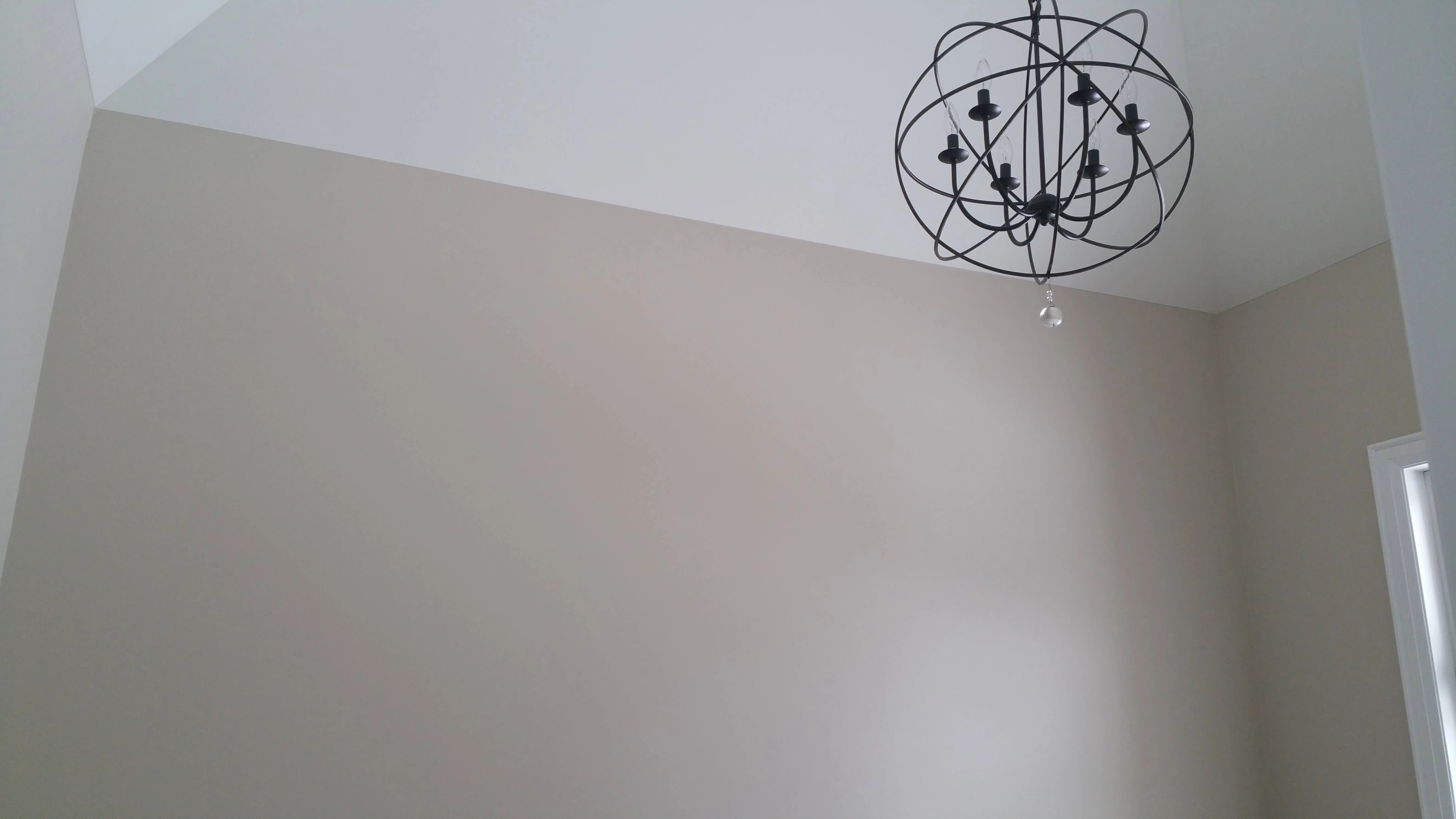
Ceilings show every mistake. Flat ceiling paint catches lap marks and inconsistencies the second you put a pot light below them. The trick is two things: a dedicated flat ceiling product, not wall paint with the sheen knocked down, and keeping a wet edge as you roll. Lose the wet edge and you can see the lap mark from across the room. Get them both right and the ceiling reads as one even plane. On 9-foot or taller ceilings (common in newer towers and any loft conversion), we add about 20 percent for the staging and the cutting-in at height.
High ceilings and tricky surfaces
Tall ceilings need a real platform or a long extension pole, not a step stool you wobble on. That's about safety, but it's also about finish quality. A painter reaching past their shoulder for ten minutes at a time can't keep a clean line. Older buildings sometimes have textured or stippled ceilings that take their own approach, and water-stained ceilings (usually from a leak in the unit above) have to be primed with a stain-blocker before any paint goes on.
I've walked into Yorkville units where the previous painter just rolled fresh white over a water stain and called it done. The stain ghosted back through within a couple of weeks. Latex stain-blockers don't hold on real water damage either. You need shellac, like Zinsser B-I-N. The point is prep is the entire game on ceilings. Our painting a condo ceiling the right way walkthrough covers stains, texture, and high-reach access.
How to choose colours for a condo

The single biggest colour variable in a Toronto condo is the light hitting the walls. North-facing units get cooler, bluer daylight all day; warm whites and greiges balance that. South and west-facing units take cooler tones well. And there's a wrinkle specific to downtown: the tower-shadow effect. If your window faces into another building rather than open sky, the effective light pulls cooler no matter which way you technically face. Always test large samples on the actual walls under your own lighting before you commit. A chip in the store never looks the same as a wall at home.
In a small unit, keep it light and flow it across rooms
Soft greiges, warm whites, and pale taupes are the most reliable performers in compact units. They reflect light, and the eye travels without interruption. The smaller the unit, the more a single flowing colour across open-concept walls helps. Too many colour breaks chop a compact space into smaller visual boxes. Trim and walls in closely related tones (rather than high contrast) makes ceilings feel taller. Save bold colour for one considered accent rather than spreading it across a small footprint. For specific picks, see the best paint colours for small condos.
Whites are about undertones, not "which white"
White is the most-requested colour we paint, and the most common mistake we get called to fix is the wrong undertone for the room. A yellow-undertone white reads creamy and warm in one unit and slightly dingy in another. A grey or blue-based white looks crisp in a bright room and cold and flat in a dim one. Trim whites and wall whites also have to relate to each other or the room looks mismatched. We keep a working shortlist of Benjamin Moore whites in the best white paint colours for condos, broken down by undertone and light.
Accent walls work, on the right wall
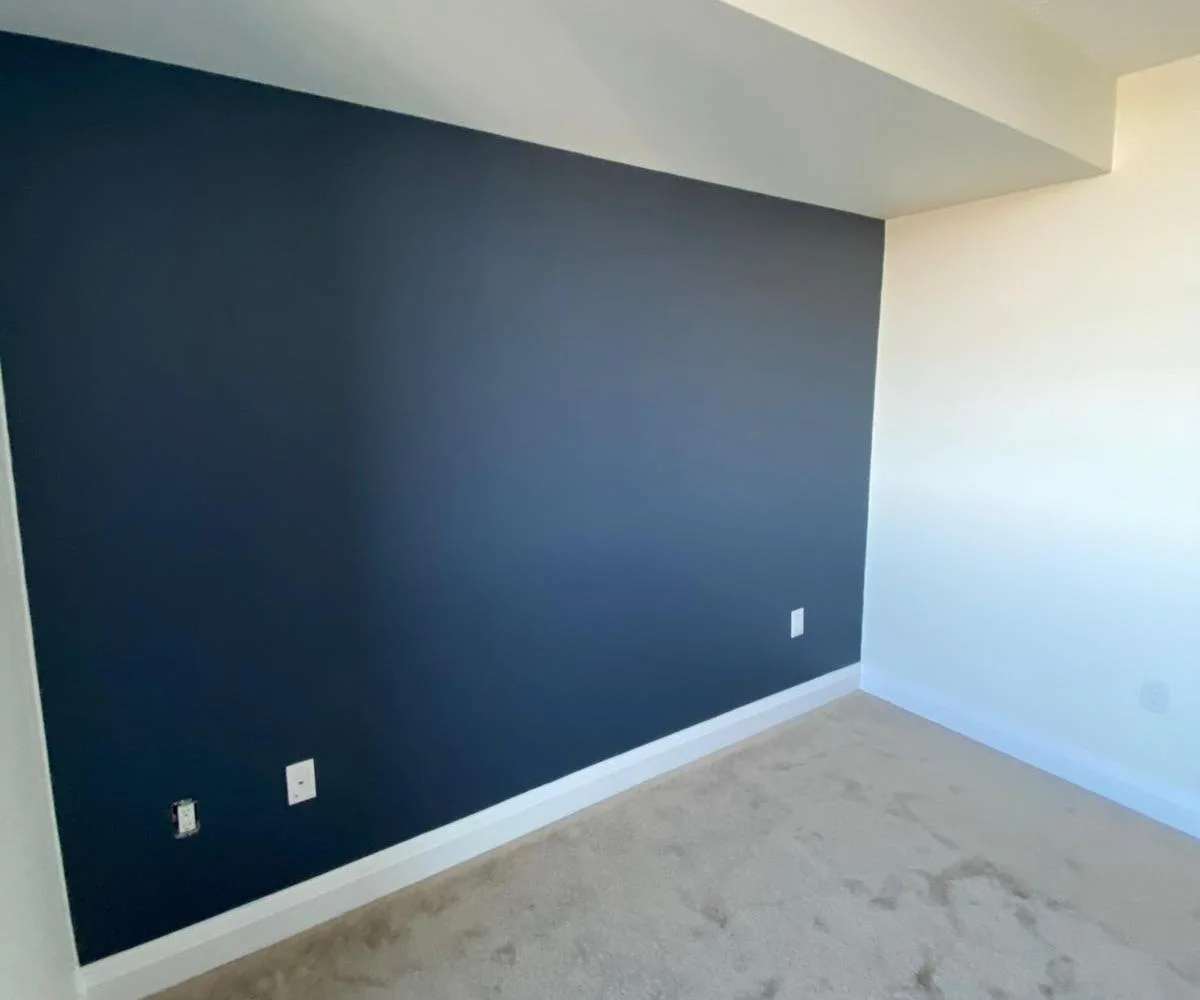
A well-placed accent wall adds depth without the cost or commitment of repainting the whole unit. The trick is picking the right wall: behind a bed, behind a sofa, or one framing a view. Deep navy or charcoal behind the bed grounds the room. A wall that wraps an alcove or media area defines the space. Don't accent a wall broken up by doors and windows; the colour ends up in awkward fragments. For rental or pre-sale units, skip the bold accent. Strong colours narrow the buyer pool.
Last fall I had a Liberty Village hard-loft client who wanted Hale Navy on all four bedroom walls. Beautiful colour. Wrong call for a 12-by-12 bedroom with one window. We talked her into the navy on the bed wall only, with White Dove on the other three. The room reads twice as deep as the all-navy version would have, and the navy actually pops because it has the light surfaces to bounce against. That's the principle: accent walls work because of the contrast, not in spite of it. Our condo accent wall ideas shows placements that work in real Toronto floor plans.
Which paint finish or sheen is right for each room?
One sheen across a whole condo is almost never the answer. The reason is simple: a kitchen wall, a bedroom wall, and a baseboard are doing three different jobs. We talk about sheen using the Master Painters Institute gloss-level system because it gives us actual numbers instead of the vague "eggshell-ish" language you get on some residential quotes.
| Room | MPI gloss level | Common label | Why |
|---|---|---|---|
| Living room, bedrooms | G3 | Eggshell | Hides minor wall imperfections, still washable |
| Hallways, dining | G3 or G4 | Eggshell to satin | Higher traffic, more frequent wiping |
| Kitchen walls | G4 | Satin | Resists grease and moisture |
| Bathroom walls | G4 to G5 | Satin to semi-gloss | Mildew resistance, scrub durability |
| Trim, doors, baseboards | G5 | Semi-gloss | Durability and visual contrast with G3 walls |
| Ceilings | G1 | Flat | Hides minor ceiling defects, no glare under pot lights |
MPI gloss levels are what the US Military, GSA, AIA MasterSpec, and most institutional Canadian specs use. So when we say G3 or G5, those are real numbers, not adjectives.
Matching sheen to lighting
Condo pot lighting is the wildcard. It's bright, it's direct, and it rakes across walls at a low angle. That's exactly the lighting condition that makes a glossier sheen show every flaw underneath. Run a G5 semi-gloss across a brightly lit open-concept living room wall and every roller mark, every patch, every seam is going to read back at you under those lights. That's a mistake we've been called to fix more than once. The flip side: G1 flat is great on ceilings and the occasional low-touch accent wall, but it marks the second you touch it, which is why I'd never use it on a hallway, a kid's room, or a rental turnover.
For the room-by-room decision guide, see choosing the right paint finish for a condo.
What are the best paint brands for condo painting?
We paint Benjamin Moore, exclusively. The coverage, the colour depth, the washability all hold up in high-traffic condo work, and the products turn over cleanly between coats. But the brand is only half the call. Which line you use matters as much.
Picking the right line for the job
Regal Select is the workhorse. Living rooms, bedrooms, most of what we paint. Durable, washable, forgiving to apply if your prep is honest. Available from flat to semi-gloss. Recoats in about an hour at room temperature per the TDS.
Ultra Spec is what I reach for on rentals and pre-listing turnovers. It's a premium-commercial product built for institutional use, which means the coverage and scrub resistance are tuned for a unit that's going to take traffic between tenants. It's also the line where the cost-per-square-foot lets us stretch a tighter pre-sale budget without dropping into builder-grade paint.
Aura is the top tier. It's what I spec when an owner wants the richest colour and the best washability, and it's the only line I use on any sensitive-household job because it's zero-VOC across the deck. Per the Aura TDS, it covers 350 to 400 square feet per US gallon at a 4.3 mil wet film and runs about 42% solids. That coverage number is the easiest way to sanity-check any quote you get. A real two-coat job on 2,400 square feet of wall surface needs 12 to 14 litres per coat. A quote that says "two gallons" for a whole unit is planning one thin coat. Now you know.
Washability is a measurable number
A paint's washability is measured, not marketed. ASTM D2486, the standard scrub-resistance test, reports cycles-to-failure under abrasive scrubbing. A wall paint clearing 1,400 cycles is rated "very good." Premium interior latex like Aura and Regal Select sits comfortably above that threshold. Bargain builder-grade paint commonly fails between 100 and 300 cycles. That gap is why the same "two-coat" job done with two different products produces very different results five years in.
For a fuller line-by-line comparison see the best paint brands for condo projects. In a tower with sealed-window air and pot lighting that exposes every flaw, the product matters more than in a detached house. A cheap paint that marks or fails to cover in two coats costs you more in callbacks and early repaints than the premium would have cost up front.
Ready for a fresh-looking condo?
That's about everything I'd cover on a walkthrough. If you want a real, itemized price for your unit, send a few photos through the quote form and I'll walk you through the colours, finishes, timeline, and the building paperwork. We paint Benjamin Moore only, handle the elevator booking, COI, and WSIB clearance directly with your building, spot-test anything pre-1990 before aggressive prep, and back the workmanship for five years.
Written by Chad Saygili, Co-Owner, Condo Painters Pro.
Chad Saygili is co-owner of Condo Painters Pro, a Toronto condo painting specialist. He has spent years painting condos across Toronto and the GTA, works exclusively with Benjamin Moore, and backs every job with a 5-year workmanship warranty.
MORE ABOUT OUR TEAM →